
Johnson County Parole or Probation
Parole and probation can both place a person in the community under rules, reporting duties, and TDOC supervision. They begin in different ways. The Tennessee Board of Parole authorizes parole before a prison sentence expires. A trial court orders probation as part of a sentence. Probation may start without a prison term, after split confinement, or through another lawful sentence structure. TDOC supervises both groups in the community, but TDOC does not turn a probation order into parole merely because the same field office manages each case.
A favorable parole decision is not the same as physical release. TDOC states that prerelease conditions may apply and that a probation or parole office must approve the release plan. A pre-parole rescission can end a grant before the person leaves custody. Probation also has its own start point. TDOC says a person placed on probation or released from split confinement must report within 48 hours. The judgment, FOIL status, and supervising-office instructions should be read together.
| Point | Parole | Probation |
|---|---|---|
| Who authorizes it | Tennessee Board of Parole | Sentencing court |
| Custody link | Conditional community release before sentence expiration | Sentence may begin in the community or follow confinement |
| Who supervises | TDOC community supervision | TDOC community supervision |
| Best records | FOIL, Board decision, and TDOC confirmation | Court order, FOIL, and TDOC confirmation |
- Parole
- Conditional release authorized by the Board before sentence expiration.
- Probation
- A court-ordered sentence served under community rules.
- Discharge
- The formal end of a custody or supervision obligation.
- Absconder
- A legal supervision status that must come from an authorized record, not a missed search result.
Verify Johnson County Post-Release Supervision
Begin with the TDOC Felony Offender Information Lookup, or FOIL, when the person has a Tennessee felony custody or supervision history. The live search accepts a name, TDOC ID, or State ID. Name search includes an optional race filter and an aliases choice, followed by a CAPTCHA. TDOC says a result may contain an image, incarceration or supervision status, location, offenses, sentence facts, hearing status, and release information. “May” matters. One field is not promised for every record.
- Confirm that the case belongs to TDOC rather than a county-only booking.
- Search FOIL with the most exact identifier available and compare similar results carefully.
- Read status, sentence, release, location, and hearing details as a set. Do not translate “inactive” into a specific release reason.
- For probation, obtain the court judgment or later supervision order. For parole, obtain the final Board decision if the status is disputed.
- Call TDOC District 10 to confirm the assigned office and current reporting route.
The broader Johnson County released-inmate search and the county release-record path are on the Johnson County released inmates home page. That local route is essential when the person had only a Johnson County Jail episode and never entered the state felony system.
Johnson County Supervision Office Routes
Johnson County sits in TDOC District 10. The directory identifies a Carter and Johnson field office in Elizabethton, while the District office is in Johnson City. The live Carter/Johnson entry reviewed for the research supplied no telephone, so a direct number should not be invented. TDOC also lists a courtesy-reporting point in Mountain City at Northeast Correctional Complex. A courtesy site can accept a report under agency direction, but it does not prove that the site holds or supervises a given case.
Carter and Johnson Field Office
419 West Elk Avenue, Suite 3
Elizabethton, TN 37643
Fax: 423-542-5039
TDOC District 10
195 Freckles Court
Johnson City, TN 37601
423-434-6800
Fax: 423-434-6830
Mountain City Courtesy Location
Northeast Correctional Complex
5141 Highway 67 West
Mountain City, TN 37683
Routing: 423-434-6800
The official Carter and Johnson supervision directory shows the office routing used for this part of Tennessee.
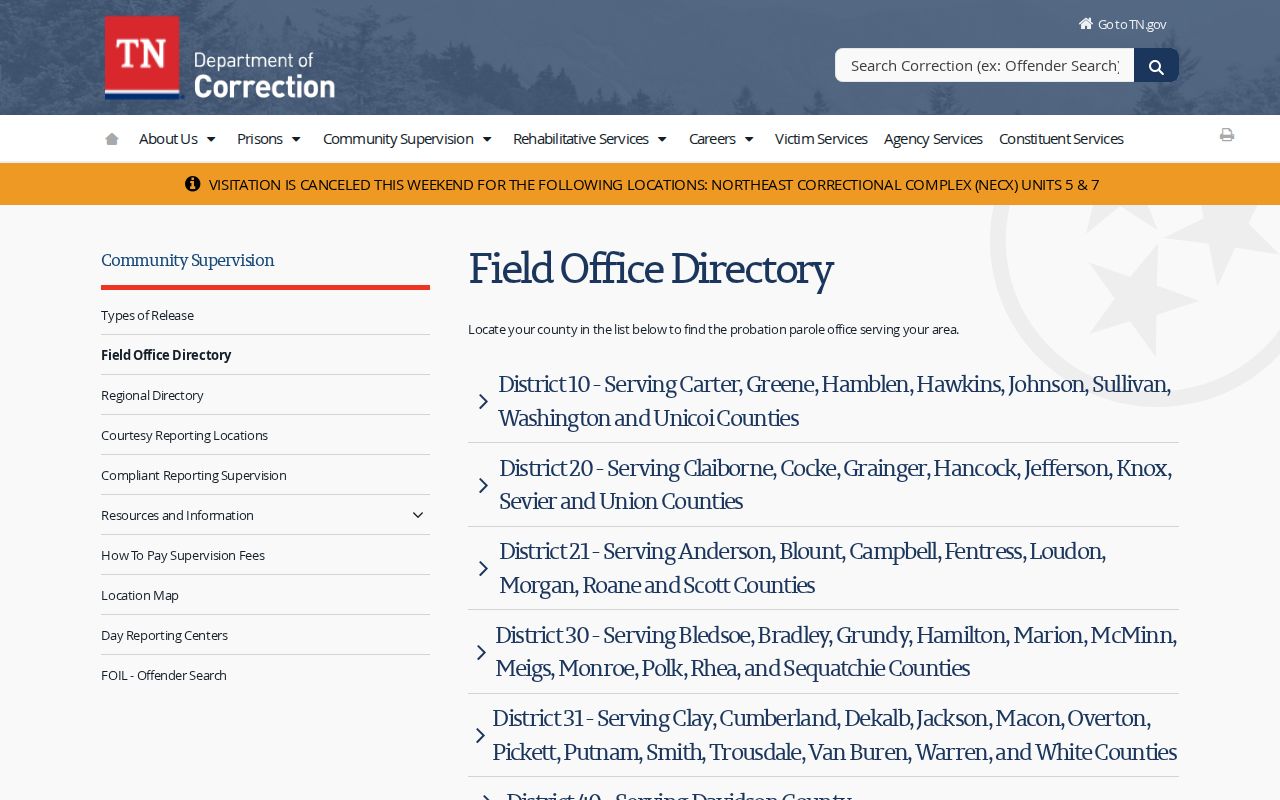
The directory image helps distinguish the assigned regional field structure from the Mountain City courtesy-reporting location.
Where Johnson County Parolees Report
The local reporting geography can be misleading. The Carter and Johnson office is in Elizabethton, outside Johnson County, while the courtesy location is at NECX in Mountain City. A person’s home county, former prison, and assigned officer may point to different places. The prison location does not control the assignment. Moving between TDOC facilities also does not establish that community supervision has begun.
Use FOIL to identify the state relationship, then obtain reporting directions from District 10. Confirm the address before appearing because the courtesy directory lists a different highway number than the main prison’s official facility address. That mismatch should not be silently resolved by assumption. The main district number is the sound routing channel.
Note: A courtesy-reporting listing is an agency access point, not public proof that a named person reports there.
Johnson County Supervision Violations
Conditions are the enforceable rules attached to parole or probation. Their exact terms come from the Board certificate, court order, and TDOC instructions. A violation allegation can lead to investigation, a warrant, a preliminary or final revocation hearing, or another authorized response. Revocation means the supervising authority ends community status and may return the person to custody. Reinstatement means supervision continues under the decision entered in the case.
No official public statewide name-based absconder or warrant list was verified. A blank FOIL result, an old address, or an “inactive” label cannot be reported as an absconder finding. Check the court that issued a probation order, TDOC, or the Board as appropriate. VINELink may provide custody-change alerts, but it is not a warrant database and cannot certify supervision compliance.
Tennessee uses several other exact labels. Determinate release is described by TDOC as a special form of probation for certain short qualifying felony sentences. Mandatory reentry supervision applies under the offense-date and eligibility rules in Tenn. Code Ann. § 40-35-506. Community supervision for life under § 39-13-524 begins after specified sentence components. Each should retain its formal name.
A supervision inquiry should keep custody events separate. Arrest on an alleged violation, transport for a hearing, and final revocation are not the same event. A preliminary hearing can address whether there is cause to proceed, while the final decision determines the supervision consequence. If the person returns to Johnson County Jail, ask whether the booking is for a new charge, a supervision warrant, or temporary detention for another authority. The court docket or Board record then supplies the legal action. This two-record check prevents a custody alert from being overstated as a final revocation.
Johnson County Parole Hearing Records
The Tennessee Board of Parole hearing schedule page says state-prison and county-jail schedules are updated weekly on Monday, or Tuesday after a Monday holiday. Current schedule access is by email request to BD.HearingSchedules@tn.gov. Last-minute changes can occur, so the Parole Hearings Division at 615-741-1150 remains the confirmation route. The page is not a public name-search calendar.
Hearing labels describe different questions. Grant hearings consider parole. Preliminary and final revocation hearings address alleged violations. Custodial hearings consider parole from one sentence to another, while rescission can cancel a grant. Time-setting decides when a new felony sentence begins. Hearing-officer recommendations are not final by themselves because Board Members may adopt, change, or reject them.
The official Board hearing-types page illustrates these separate proceedings.
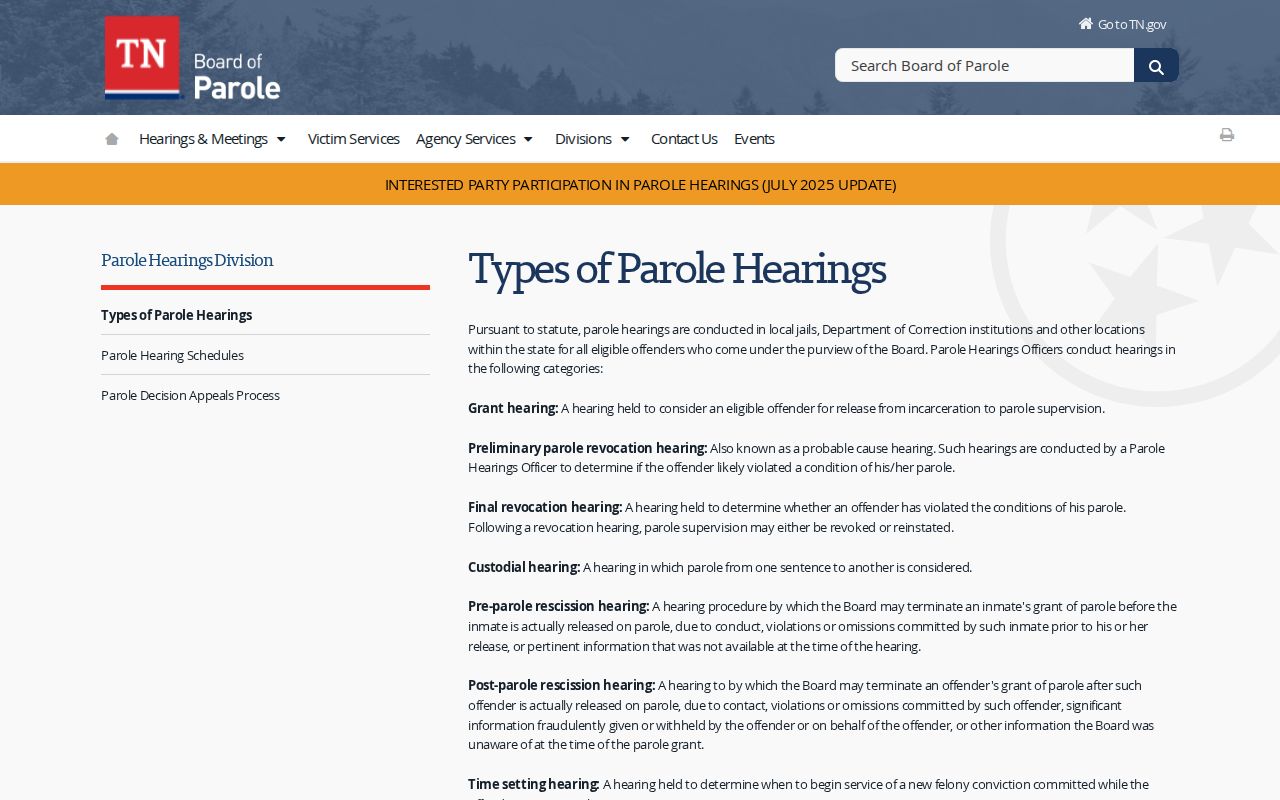
The captured page reinforces why a hearing entry must be read by type before drawing a conclusion about release or supervision.
No verified public decisions archive allows a Johnson County name search. FOIL may show hearing status, but a final result should be confirmed through the Board or TDOC record. The appeals procedure describes qualifying grounds and a filing deadline after receipt of a final decision; it is not a results search. Some county-jail hearings allow virtual public attendance through the Board request process. Other access remains subject to facility security and space. Attendance, a schedule entry, and the final written decision each prove a different fact.
Ending Johnson County Post-Release Supervision
Supervision ends through an official discharge or other final agency or court action, not because a person stops appearing at an old address. FOIL may show an inactive relationship, but the exact status and effective date should be taken from the record that created them. For parole, Board and TDOC records establish the end point. For probation, the sentencing court and TDOC record establish whether the term expired, was discharged, modified, or revoked.
Tenn. Code Ann. § 40-35-501 governs release eligibility, and § 40-35-503 supplies parole criteria. Those statutes do not make an eligibility date an automatic discharge date. A precise verification records the label shown, the date accessed, and the agency contacted. If a copy is required, request the existing order or discharge record rather than asking an office to create a conclusion about whether the person is free of all legal obligations.